Boho Baby: A Handwritten Font That Brings Warmth, Character, and Versatility to Your Design Projects
If you're designing for a brand that values authenticity, softness, and timeless charm—whether it's a boutique baby clothing line, a mindful parenting blog, or an eco-conscious nursery decor shop—you’ve likely searched for a typeface that feels personal without sacrificing professionalism. Boho Baby is more than just another handwritten font. It’s a thoughtfully crafted typographic voice inspired by classic letterforms, yet unmistakably modern in its rhythm, contrast, and expressive range.
Unlike many script fonts that lean too ornate for readability or too casual for credibility, Boho Baby strikes a rare balance: it’s warm enough for heartfelt messaging, structured enough for visual hierarchy, and flexible enough to scale across platforms—from tiny mobile headlines to large-format print posters.
What Makes Boho Baby Different—and Why It Matters to You
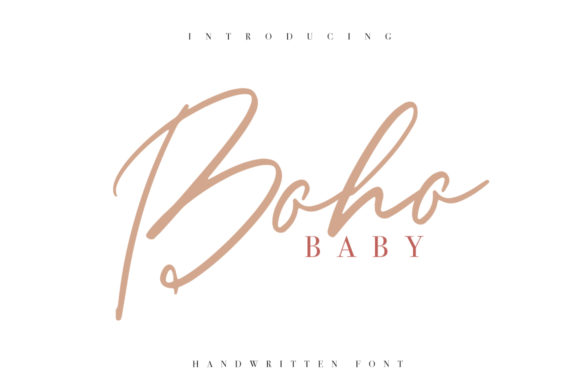
At its core, Boho Baby is a versatile handwritten font designed with intention—not just aesthetics. Its inspiration comes from vintage typography, but its execution is purpose-built for today’s design needs. The letterforms feature subtle variations in stroke weight, natural entry and exit strokes, and carefully calibrated spacing that supports both rhythm and legibility.
This isn’t just “pretty handwriting.” It’s a tool engineered for real-world use. For example:
- Headlines of all sizes—from bold hero banners to delicate subheads—retain clarity and personality without distortion.
- Blocks of text (like product descriptions or email newsletters) benefit from its dual-range variation: some characters carry gentle flourishes for visual interest, while others simplify for consistency and flow.
- Cross-platform reliability means Boho Baby performs equally well on websites (with proper webfont implementation), printed packaging, animated social media stories, and even embroidered labels when paired with vector-based rendering.
Real Challenges—And How Boho Baby Offers Practical Solutions
Designers, small business owners, and content creators often face overlapping challenges: standing out in a crowded digital space, communicating warmth without seeming unpolished, and maintaining brand cohesion across diverse touchpoints—all while working with limited time or technical resources.
Consider these common situations—and how Boho Baby helps:
You’re launching a new baby lifestyle brand. Parents increasingly seek brands that reflect their values: gentleness, sustainability, individuality. A sterile sans-serif might feel too clinical; an overly decorative script can feel insincere. Boho Baby bridges that gap—its organic flow evokes care and craftsmanship, while its consistent x-height and open counters ensure your product names, taglines, and calls-to-action remain clear and trustworthy.
You’re redesigning your website or Shopify store. Typography impacts bounce rate and conversion. With Boho Baby, you can use it strategically: as a display font for headings and buttons (paired with a clean, highly legible body font like Lora or Inter), creating instant visual distinction without sacrificing accessibility. Just be sure to serve it as a web-optimized WOFF2 file and define fallbacks—this keeps load times low and ensures graceful degradation.
You create print collateral—invitations, wall art, or packaging. Print demands precision. Boho Baby includes OpenType features like contextual alternates and ligatures, allowing subtle refinements that elevate craftsmanship. When used at 24pt or larger in greeting cards or nursery prints, its nuanced stroke variation adds tactile depth—even in flat CMYK output.
Practical Applications You Can Implement Today
You don’t need advanced design skills to harness the strengths of Boho Baby. Here’s how different users can apply it meaningfully:
- Small business owners can use Boho Baby for logo lockups, Instagram story highlights, and email subject lines—prioritizing high-impact, low-effort placements where personality matters most.
- Freelance designers benefit from its adaptability across client industries: wellness, children’s education, handmade goods, or wedding stationery. Because it scales so well, one license often covers multiple deliverables—web, social, and print—reducing font licensing complexity.
- Content creators and bloggers can integrate Boho Baby into Canva templates for quote graphics or Pinterest pins. Just remember: limit its use to short, emotionally resonant phrases (“Breathe Deeply”, “Grow Gently”, “Made With Love”)—not long paragraphs—to preserve impact and accessibility.
Smart Considerations Before You Use Boho Baby
Like any powerful tool, Boho Baby delivers best when used with awareness. Keep these practical points in mind:
- Pair intentionally. Avoid pairing with other scripts or overly decorative fonts. Instead, choose a neutral, humanist sans-serif (e.g., Poppins or Nunito) or a gentle serif (e.g., Merriweather) for body text. Contrast creates harmony—not competition.
- Respect hierarchy. Use Boho Baby for emphasis, not uniformity. Reserve it for headlines, pull quotes, logos, or accent elements. Let supporting fonts handle information density.
- Test for accessibility. While highly legible at appropriate sizes, avoid using Boho Baby for small UI text (<16px), long-form body copy, or low-contrast backgrounds. Always check color contrast ratios (aim for at least 4.5:1 against white or light neutrals).
- Licensing matters. Confirm usage rights match your needs—especially if you’re embedding in apps, SaaS platforms, or selling digital templates. Most standard licenses cover desktop and web use, but extended permissions may be needed for merchandise or redistribution.
More Than a Font—A Design Ally for Meaningful Work
In a world saturated with algorithm-driven visuals and templated aesthetics, choosing a font like Boho Baby is quietly intentional. It signals care—not just in how something looks, but in how it feels to the person reading it. That emotional resonance translates directly into trust, engagement, and connection.
Whether you're naming a newborn’s first onesie collection, crafting a slow-living newsletter, or designing signage for a holistic pediatric clinic, Boho Baby offers a grounded, human-centered foundation. It doesn’t shout—it invites. It doesn’t overwhelm—it comforts. And because it works so reliably across contexts, it saves time without compromising quality.
So if your goal is to communicate warmth without vagueness, elegance without pretense, and individuality without inconsistency—Boho Baby isn’t just a stylistic choice. It’s a strategic one.