Thai Coala: A Friendly Handwritten Font for Thai Language Design
Thai Coala stands out in the landscape of Thai-language fonts—not as a technical powerhouse or a high-contrast display typeface, but as a consistently warm, approachable, and human-scaled handwritten option. It’s designed to feel personal without sacrificing legibility, casual without drifting into illegibility, and expressive without requiring expert typographic knowledge to use well.
What makes Thai Coala distinct is its intentional balance between authenticity and usability. Unlike some handwritten Thai fonts that lean heavily into irregular stroke weight or exaggerated flourishes—making them better suited for single-word logos than body text—Thai Coala maintains rhythmic spacing, consistent baseline alignment, and clear glyph differentiation across common Thai consonants, vowels, and tone marks. Its curves are soft but controlled; its terminals taper gently rather than flicking unpredictably. That restraint gives it versatility few casual Thai handwriting fonts achieve.
How Thai Coala Handles Thai Glyphs
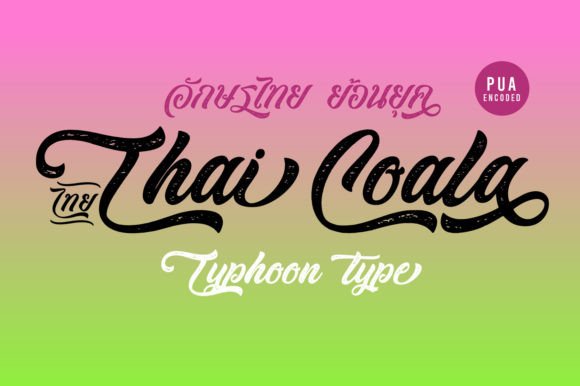
Thai Coala includes full Thai glyph coverage—including all 44 consonants, 28 vowel forms (including compound and above/below placements), five tone marks, numerals, punctuation, and common ligatures. Crucially, it’s PUA (Private Use Area) encoded. This means every alternate glyph, swash, contextual form, and stylistic variant is accessible directly through standard font menus in design tools like Adobe Illustrator, Photoshop, or Figma—no need for OpenType feature tags or complex CSS workarounds. For designers who want expressive variation without scripting overhead, that’s a meaningful practical advantage.
The inclusion of multiple glyph options—such as alternate lowercase ก, ด, and ป with subtle variations in loop size or entry stroke angle—lets users fine-tune tone without switching fonts. You might choose one version for a logo (more compact, stable), another for social media headers (slightly bouncier), and a third for greeting card illustrations (with added flourish). These aren’t decorative extras—they’re functional variants calibrated for real-world readability at different sizes and contexts.
Where Thai Coala Fits Among Thai Font Categories
Thai typography broadly falls into three overlapping categories: traditional serif/sans-serif (e.g., TH Sarabun, Prompt), display or decorative fonts (often high-contrast, stylized, or thematic), and handwritten or script fonts. Thai Coala lives firmly—and intentionally—in the last group, but avoids the pitfalls many in that category face.
Some Thai handwritten fonts prioritize artistic flair over function: they may lack proper tone mark positioning, compress vowel clusters awkwardly, or render certain consonant combinations indistinct at small sizes. Others are overly simplified—reducing strokes to near-monoline forms that lose the organic rhythm essential to natural handwriting. Thai Coala sits between those extremes. Its stroke contrast is modest (enough to suggest pen pressure, not so much that thin parts vanish at 14pt), and its vowel placements follow conventional Thai typographic logic—not just visual mimicry.
This makes Thai Coala especially effective where warmth and personality matter, but clarity can’t be compromised: brand identities for cafés, wellness studios, indie publishers, or lifestyle blogs targeting Thai-speaking audiences aged 20–50. It communicates approachability without sounding childish, and craft without sounding obscure.
Realistic Use Cases and Practical Limits
Thai Coala excels in short-form, high-impact applications:
- Logos and wordmarks: Its friendly weight and consistent x-height make it highly legible even when scaled down on app icons or business cards.
- Social media visuals: Works well in Instagram carousels or Facebook banners where tone and relatability drive engagement more than formal precision.
- Greeting cards and invitations: The PUA-encoded swashes allow quick customization—swap in a flourished ส for “สุขสันต์วันเกิด” without manual vector editing.
- Illustrated packaging or merch: Pairs naturally with hand-drawn elements, watercolor textures, or soft color palettes.
It’s less suitable for long-form reading—think multi-page brochures, documentation, or UI text fields. While readable at 16–18pt, its handwritten nature introduces subtle inconsistencies that accumulate over paragraphs. Similarly, Thai Coala isn’t optimized for screen rendering at very small sizes (under 12pt) on low-DPI displays, where sharper sans-serifs like Kanit or Noto Sans Thai often perform more reliably.
Comparing Fit: When Thai Coala Is the Right Choice
Choosing Thai Coala comes down to intent, audience, and context—not just aesthetics. Ask yourself:
- Is the goal to convey warmth, intimacy, or artisanal care? If yes, Thai Coala supports that intention more directly than neutral sans-serifs.
- Will the text appear mostly in headlines, labels, or short bursts? Then its strengths align well with usage patterns.
- Do you need expressive flexibility without technical complexity? The PUA encoding lowers the barrier for non-typographers to access alternates.
- Is your audience likely to notice—and appreciate—nuanced Thai typography? Design-literate Thai users often respond positively to thoughtful, well-spaced handwritten fonts that respect linguistic structure.
If your project leans toward editorial rigor, multilingual interface design, or accessibility-first communication (e.g., government services or educational materials), Thai Coala may not be the primary tool—even if used sparingly for accents. In those cases, pairing it with a robust, highly legible Thai sans-serif (like IBM Plex Sans Thai or Sarabun) often yields stronger results than relying on it alone.
Tradeoffs to Acknowledge
No font solves every problem, and Thai Coala is no exception. Its friendliness comes with built-in constraints:
- Limited language support beyond Thai: While Latin characters are included, they’re designed to harmonize—not match—Thai proportions. Don’t expect seamless bilingual typesetting for English-heavy layouts.
- Fewer optical sizes: Unlike professional type families with dedicated caption, text, and display cuts, Thai Coala offers one well-tuned design. That’s efficient—but means you’ll rely more on manual scaling and tracking adjustments for extreme sizes.
- Less typographic hierarchy out of the box: It doesn’t include bold or italic weights. Stylistic distinction must come from size, color, spacing, or pairing—not weight contrast.
These aren’t flaws—they’re design decisions. They reflect Thai Coala’s focus: to be an expressive, reliable, and accessible voice for Thai-language expression in contexts where personality matters most.
Making a Practical Decision
Before licensing or downloading Thai Coala, test it with your actual content—not just sample phrases. Try setting common Thai words with stacked vowels (เครื่อง, เพลิดเพลิน) and tone combinations (มา, ม้า, ม่า, ม๊า, หม่า). Check how it renders in your target medium: on screen, in print, alongside your brand colors, and next to any companion fonts you plan to use.
If it feels cohesive, legible, and aligned with your brand’s emotional tone—then Thai Coala is likely a strong fit. If you find yourself constantly adjusting spacing, avoiding certain words, or needing to fall back on another font for clarity, that’s useful data too. Not every project needs handwriting. Sometimes the quiet confidence of a well-proportioned sans-serif says exactly what’s needed.
Thai Coala doesn’t replace other Thai fonts—it complements them. Used thoughtfully, it adds dimension to a typographic system. Used without attention to context, it can dilute impact. Like any expressive tool, its value emerges not from what it is, but how and why it’s applied.